
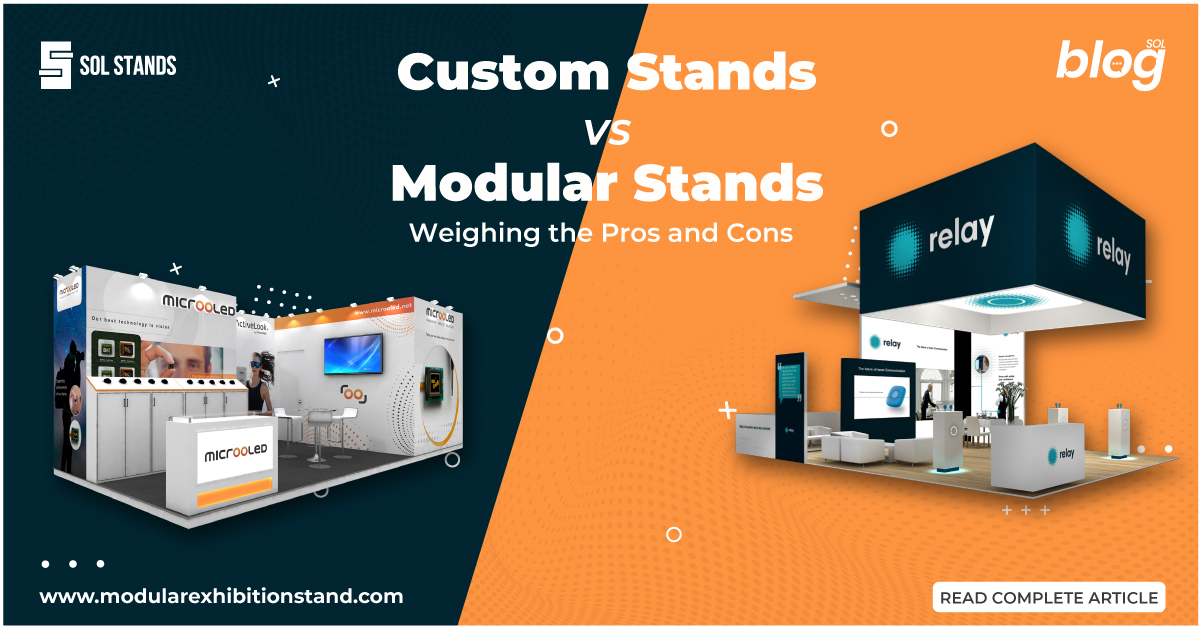
Trade show booths or stalls enable one to put creativity into displaying their brand while at the same time helping in the marketing of their products and or services to the attendees. When comparing modular stands with custom stands, there are a few important factors with respect to flexibility, aesthetic design, costs, etc. Still, this blog post outlines the main advantages and disadvantages of each choice to support your decision.
Modular Stand Pros
-
Cost-Effective
Modular stands are readily available as an ‘end-to-end’ solution that does not require much effort to set up. None of the pieces are custom-made, which makes it much cheaper than having each piece built from the ground up. This makes it possible for small businesses as well as start-up companies to showcase professionally despite the constraints of their financial capacity.
-
Adaptability
Modular systems are easy to tinker with since their component parts can be rearranged and layouts changed in preparation for future use. It allows you to rebuild the parts rather than a completely different stand every time. Other advantages of modular design include mixing, matching, and reconfiguring modular elements, which make it easier to experiment with what configuration works best for engagement.
-
Quick Assembly/Disassembly
In a modular stand, there is a basic design of attaching and detaching; the system can be easily connected using hooks or a magnet system, making it fast to set up or dismantle. This makes it easier to transport and store between events and prevent cross-contamination between different products. It also offers some main advantages for making final changes to layouts at the location, if necessary.
-
Storage Convenience
Arranging components on top of one another is made easier because of their modular forms as they self-assemble due to the uniformity in shape and size, thus occupying less space when being stored or when in transit. This is rather challenging to do, particularly when feting custom-fabricated exhibits with odd contours and spurs—their small size results in easy storage and shipping and reduced costs for both.
Modular Stand Cons
-
Lack of Originality
Because most vendors provide limited choices of components that make up a modular system, it means that there’s less differentiation possible. Even though one can incorporate a company’s logo in the design of modular trade show exhibits, the displays look more off the shelf. This may not be well suited to corporates wishing to portray innovation or a different company brand.
-
Design Limitations
The large shape and size of pre-set components and their combinations make it very challenging to have a desired layout, especially if not configurable to have customized stands built to order. Furthermore, the number and variety of multi-level structures, height, and asymmetrical structures are limited in terms of the available modular parts.
-
Structural Instability
Some of the common disadvantages of modular stands include that they are normally designed to support less weight than conventional stands; they can move around when bumped or shaken and cannot hold some materials such as concrete or tile. These constraint options of top display and may cause the toppling of hazards.
Custom Stand Pros
-
Originality
Standalone exhibits made for your company crafted from the ground up offer uniqueness that is not possible with modular systems. Specific and unique themes display the attendee’s attention more while providing a concise, noticeable message that the brand is different from its competitors.
-
Seamless Design Execution
At this, one can state that the layout, dimensions, and material, as well as the concept of any functional item, can be realized with a unique design. These are possible to achieve if the constructions are on multiple levels with height differences and asymmetrical shapes that have a combination of different materials, lighting, technology integration, or more.
-
Structural Integrity
They are built as bespoke structures made from steel frames that are welded together, meaning they can support a very heavy load and are very rigid compared to modular units. Bricks or stones that are thicker than usual for display purposes and buildings that are more than one or two floors are well secured to allow almost any architectural dream to be implemented without compromising safety.
-
Material & Finish – The Power of Change
Modular exhibits enable potential materials from wood, plastic and metal, fabric, glass and more to be used and can be fully customized. These finish options are virtually infinite and can include laminates, paints, graphics and other services to bring together a consistent branded look that is not restricted to ready-to-wear modular looks. It also tends to outlast modular types, hence making it suitable for use in a variety of places.
Custom Stand Cons
-
High Costs
The level of customization is, however, achieved at a certain cost, whereby custom stands are always renowned for having exaggerated budgets compared to modular stands. Such costs include the cost of assembling parts and accessories that are manufactured to a client’s specifications, specialty materials where applicable and the time it takes to build each unit, which small businesses cannot afford.
-
Complex Logistics
If a design is made for a particular event, it adds to the transportation of the design, setup and breakdown, unlike the modular designs made to be simple. While it is easier to design lighter custom stands, it is important to note that they are harder to dismantle and ship because of the use of heavier materials and the use of secured connections.
-
Lack of Reusability
Generally, custom stands are designed, constructed, and painted for specific layouts and brand appearance that would allow for full reusability at other events, which is not realistic. Some may be collapsible for multiple utilization, but this incurs heavy expenses and will thus mean that total rebuilding costs will continue to be incurred.
-
Lengthy Production Timelines
A custom solution involves the design phase and its approval, which takes time before the actual fabrication begins. Creation also takes more time to craft new and innovative products in production perfectly. This lead time of 6-12 weeks may be less convenient, for instance, if there is a need to put up an exhibit immediately compared to a readily available modular part.
Conclusion
As a modular system, stand designs are cheaper and quicker to construct than conventional stands while offering reusable parts. Custom stands are outstanding due to the exclusivity of design, the aesthetics of the constructions and spatial configurations.
However, they come at a significantly higher cost than conventional channels and are also logistically more challenging. These are the pros and cons that the business needs to consider in comparison to the goal, cost, functionality and image. So, the question of an informed decision is really one of deciding where on the spectrum of possible settings the right place to be is.