
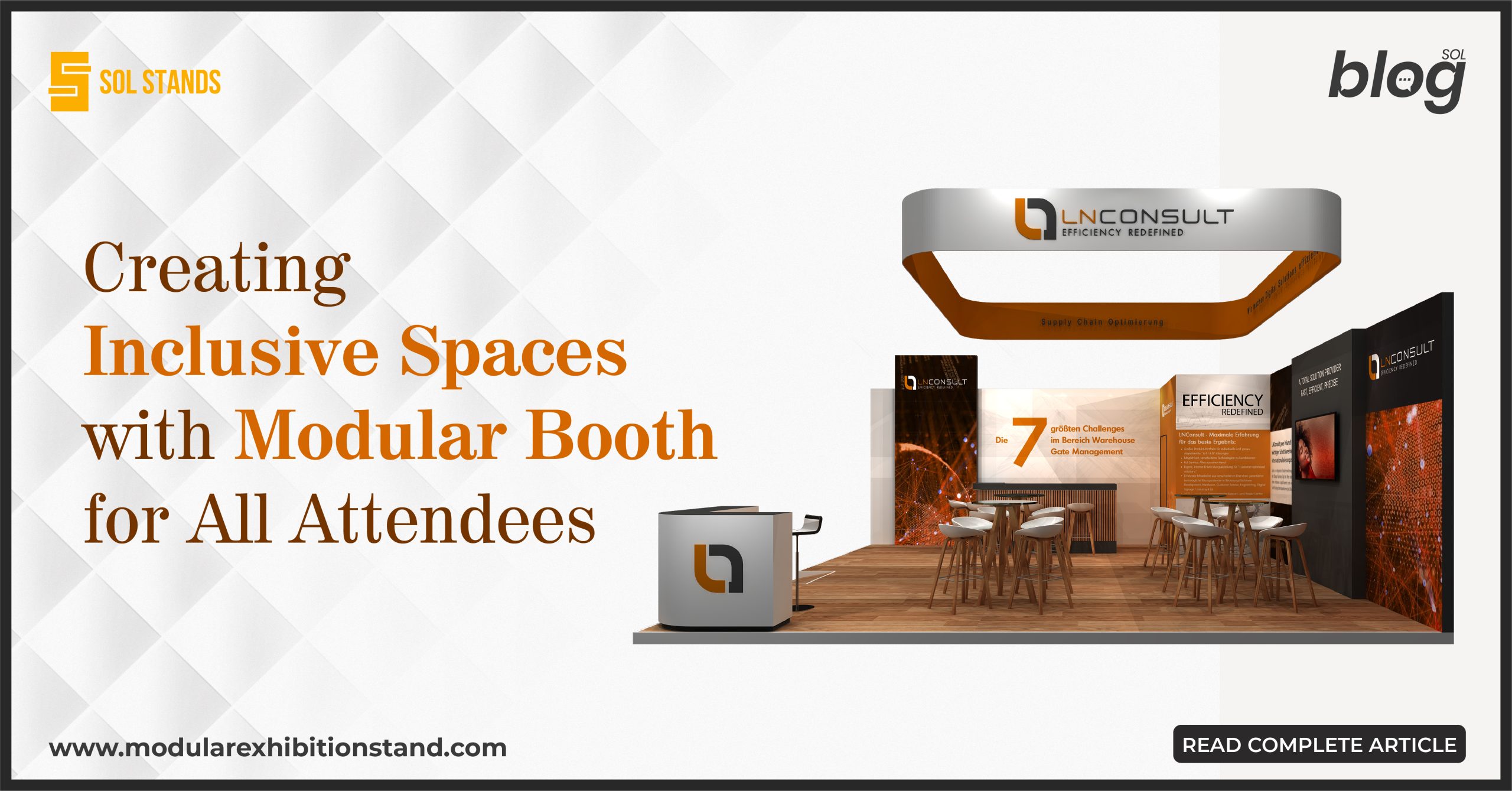
Modular booths show that event marketing and conference design are key ways of making environments that are accessible to everyone present. Since more events are catering to different ethnicities and abilities, the booth structure and design help to ensure that everybody is comfortable and can engage. In this article, the conversion of modular booths and the possibilities for accommodating attendees of different categories of disability will be discussed.
Flexible Layouts
As for its benefits, modular booths are as follows: they are easy to maneuver when it comes to layout and design. The booths can be arranged in various floor plans to accommodate different needs:
- This also means that booths and aisles may be extended wider for those who use wheelchairs or perhaps require more space. They also allow easier movement for people using the service animals to get around since the aisles are wider.
- Some of the furniture pieces that may be placed inside the booths, such as tables, chairs, and counters, can be adjustable, or there should be specific spaces that allow for wheelchair access.
- Booth models and informational kiosks can be installed at heights that are easily reached by both the standing and the seated person.
That adaptable booth area makes it possible for event planners to alter booth layouts as needed to accommodate certain attendees, which is beneficial. It generates an open environment that can accommodate all the mobility and accessibility requirements of the people.
Sensory-Friendly Considerations
There is also the question of disability access for mobility-impaired attendees, but other concerns should be accommodated for attendees with sensory issues such as noise, light, and touch sensitivity in a modular booth.
Strategies include:
- Avoiding decorative furniture and display pieces that are of clear/sharp colors/texture to prevent the space from looking cramped.
- Replacing bad lights with elements that emit a gentle, warm light instead of using fluorescents.
- Seeking material panels for fabrication with sound absorption properties that would help reduce the problem of sound bouncing off surfaces in rooms.
- Providing a particular zone, if possible, for those attendees who feel stimulated or uncomfortable within large groups.
Innovations as basic as these enable members with SPD to feel included and not overwhelmed by stimuli that are usually overbearing.
Communication Accessibility
An important component of accessibility at the booth is making communication access possible for all speaking and hearing-impaired event participants. Modular booths readily support adding the following accommodations:
- Wheelchair user-accessible tables also have an under section that sign language interpreters may use to sit. This helps in discussions with the deaf/hard-of-hearing participants as they feel comfortable embracing a conversation.
- These canine accommodations can include booths that are outfitted with assistive listening devices, real-time captioning displays, or large print/braille signage.
- Possessing easily understandable literature with simple language, in addition to clear signs with braille, also enhances the prospects of communication given to people with disabilities.
Incorporating these features into the core design of the booth means that there is no such barrier to prevent people from communicating, and everyone can participate on an equal basis if they are suffering from physical disadvantages.
Controlled Sensory Environments
Modular booth systems make it possible for event planners to design partitioned enclosures that can help control sensitivity issues such as noise, light, smell, or any other uncomfortable experience.
- Special wall coverings and floorings that have soundproofing capabilities can help in limiting noise interference that may be disruptive or harsh. White noise systems also facilitate achieving comfort in terms of sound.
- Lighting fixtures – both general and booth-specific – can also be selected in such a way as to avoid any glare or uncomfortable high-intensity lighting. Indirect lighting, or subtle lighting, as it is called, works best in creating the right ambiance.
- Finally, the application of scent-free zones is crucial for those who have multiple chemical sensitivities. For organizers, this means having no use of scented items for booths and distributing materials, as well as no scented clothing or personal accessories for attendees. They also enhance the quality of air within the facility through the use of HEPA filtration systems.
Creating Quiet Spaces
The distribution of small, quiet areas within modular booth designs enables attendees who suffer from overstimulation due to noises, lights, or crowds to rest. Quiet spaces should:
- It should be clearly sign-posted and have a few visible entrances so that it does not easily get interfered with.
- Provide chairs, distractions, and noise-reducing and light-reducing facilities.
- Ensure there is convenience in approaching companion care and lactation spaces.
When understanding the characteristics of all attendees, it is possible to make booth designs more accessible and adapt to the modular nature of modern exhibitions to make them comfortable for everyone. As demonstrated in the wide range of access needs defined above, it is crucial to fine-tune the measures of inclusion periodically.
Welcoming Aesthetics
Another aspect that is also somewhat associated with such aspects as the welcome and inclusion of attendees at events are the aesthetics and the design of modular booths. Purposeful elements include:
- Employing images, graphics, and decoration that depict people of Racial/ethnic origin, gender, and disability. This has a positive implication that such minorities will be welcomed or included in certain activities.
- Bright and colorful, often including neon light that makes a room lively, energizing people to engage.
- Having booth furniture and seating arrangements that will make attendees aggregate rather than be closed inside separate booths.
- Greenworks that are used to decorate a particular area to make it warmer and more comfortable.
As for the appearance of the event, it must be safe and inviting for people of diverse backgrounds, and the message of inclusiveness should be introduced sincerely.
Conclusion
While events seek to further the cause of DEI, modular booths provide the chance to design the event areas where everyone at the exhibition can be comfortable and engaged. It is possible to control the degree of accessibility needed by taking full advantage of the modular design created by the flexibility of the structure.
In addition, intentional olfactory and auditory integration, language modifications, and non-stigmatizing environmental graphics and design allow all individuals to be incorporated into the events. That is why, when implemented carefully, these modular booths can be a powerful tool that will help design more inclusive events.